
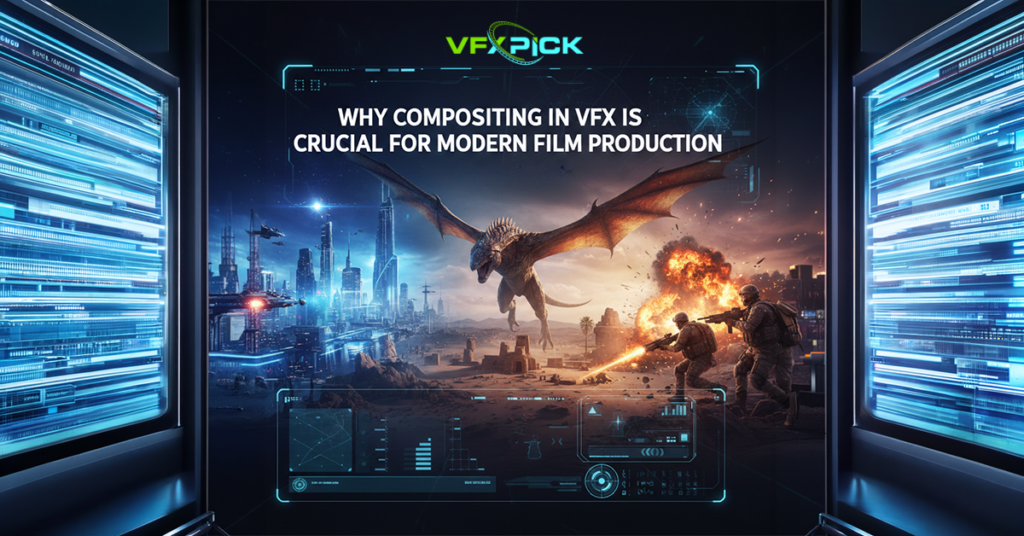
- The art of modern film is no longer confined by the sets, real effects and geographical location. Since we have intergalactic battles, historical recreation and hyper-real digital worlds, the films of today are unable to do without compositing in VFX to make imagination come true.
- However, when audiences applaud computer-generated animals or whiz-bang action shots, they are applauding compositing, the unsung hero behind the screen.
- At VFXpick, the concept of compositing is not simply the process of technical treatment, but the ultimate artistic transition through which the raw material is transformed into the world of cinema. We shall discuss the reason why compositing is the pillar of contemporary film production.
What Is Compositing in VFX?
Compositing VFX is the process of juggling one frame of a visual image, which may include live-action, CGI, matte paintings, simulations, or effects. The goal? To give the illusion of all the photographs being taken in a single shot.
In simple terms, compositing ensures that:
- A CGI dragon looks like it’s truly flying through real clouds.
- A digital city blends perfectly with filmed actors
- Explosions, smoke and lighting feel physically accurate.
This is the last phase of the process, which is otherwise called visual effects compositing and involves all the departments combining, such as modeling, texturing, lighting, animation and FX.
Even the state-of-the-art CGI would appear detached and fake without the assistance of compositing.
The Evolution of Visual Effects Compositing
From the pioneering breakthrough in Star Wars to the groundbreaking CGI in Jurassic Park, compositing has come a long way. The application of the latest blockbusters, such as The Avengers and Avatar, is associated with a very advanced compositing pipeline.
Older methods involved optical compositing, literally superimposing film strips. Nowadays, digital node systems enable artists to manipulate:
- Light and shadow integration
- Depth of field
- Motion blur
- Atmospheric effects
- Color matching
- Camera tracking data
Modification of the visual effects compositing has shifted the production of movies away from the practical constraint to unlimited creativity.
Why Compositing in VFX Is Critical for Modern Films
1. Seamless Reality Blending
The audiences are now looking into realism, even in fantasy. Compositing provides that digital and practical elements have:
- Lighting consistency of direction.
- Correct shadow interaction
- Matching grain and noise
- Unified color grading
In the absence of sound compositing, scenes are unnatural or alienated.
At VFXpick, we are concerned with our micro-level details: reflections on a glass surface, a hazy feeling in the atmosphere and edge blending, since realism exists in the details.
2. Storytelling Enhancement
Compositing is not only technical, but it is also narrative.
Filmmakers are able to:
- Focus on emotional shades through lighting.
- Include environmental narratives.
- Add dramatic effects with the delicate touch of digital.
- Eliminate distractions in real-world shoots.
As an example, some basic urban environments can be supplemented with virtual weather, distant action, or architecture changes making the mood of the story a little stronger.
3. Cost-Effective Production
It is costly and time-consuming to construct huge physical sets. Compositing in VFX permits productions to:
- Shoot on minimal sets
- Digitally replace backgrounds.
- Prolong environments in a seamless manner.
- Simulate large crowds
This goes a long way in saving on logistics and still ensuring cinematic magnitude.
Green screens and LED volumes are increasingly important in modern productions because they allow for perfect compositing in post-production.
4. Flexibility in Post-Production
Flexibility is one of the largest strengths of compositing in VFX.
Directors can:
- Transform sunshine to storm clouds.
- Modify time of day
- Add or remove elements
- Adjust tone and mood
Such a level of control guarantees creative freedom despite the fact that the principal photography is completed.
In the VFXpick, the compositing workflows are designed to be flexible in that the artists are able to make last-minute creative changes without affecting the quality.
5. Invisible Effects That Go Unnoticed
Not all VFX are explosive or fantastical. Many of the most critical compositing tasks are invisible:
- Wire removals
- Cleanup work
- Digital set extensions
- Skin retouching
- Screen replacements
If the audience doesn’t notice the effect the compositing has succeeded.
Invisible visual effects compositing maintains immersion and immersion is everything in cinema.
The Technical Layers Behind Compositing
Compositing involves multiple layers of technical precision:
- Keying – Removing green or blue screens
- Rotoscoping – Isolating elements frame by frame
- Tracking – Matching CGI to camera movement
- Color correction – Matching tones across layers
- Depth compositing – Using Z-depth for realism
- Light wrap techniques – Integrating edges naturally
All the layers should fit on each other. Even the slightest inconsistencies in the softness of the shadows or the intensity of the reflections may destroy realism.
In VFXpick, our artists consider compositing a science and an art at the same time, a combination of mathematical accuracy and intuition.
The Role of Compositing in VFX for OTT and Streaming Content
The emergence of OTT services has made good VFX less visible in movies with large budgets. On-demand series require film-quality effects to be produced within shorter timeframes.
VFX compositing is an important technique for several reasons, including:
- Speeding up order fulfillment.
- Assuring Coherence in Terms of Vision.
- Improving mid-range productions.
- Allowing high quality images without huge budgets.
Even the dialogue-oriented dramas today incorporate the visual effects compositing to contribute to the environments and production value in a subtle way.
Collaboration Across Departments
Compositing is the final checkpoint before a shot reaches the screen. It connects:
- Layout
- Animation
- FX simulations
- Lighting
- Color grading
Since it is at the tail of the pipeline, compositing artists have to be aware of all the outputs of the departments.
At VFXpick, teamwork is a key activity in our process. We incorporate feedback loops between teams to achieve the final composite, ensuring that it meets both technical and artistic objectives.
Conclusion
- To sum up, Compositing in VFX is the unseen power that turns the vision of creativity into the image of reality in the film. It makes sure that all the digital elements merge with the live action in a manner that presents the authenticity that viewers hold to contemporary movies.
- The flexibility, scalability and creative control required to break narrative conventions are made possible through composition and visual effects that are highly accurate, enabling filmmakers to provoke narrative exploration.
Compositing will be used on minor cleanups to major fantasy worlds to add both realism and emotional depth. With the changing technology, it will increasingly take center stage in the production of films. At VFXpick, compositing is not just a final step; it is the stage where imagination becomes reality on the screen.
FAQs
VFX Compositing is the technique of collaging live-action film and digital imagery in a sequence to create one complete image.
The visual effects compositing style creates a realistic appearance by integrating lighting, shadows, color and depth across all elements.
No. Compositing provides invisible effects and corrects scenes in even small films, commercials, and streaming shows.
We are familiar with industry standard node-based compositing tools and our primary pipeline for compositing is Nuke, which allows precise control over layers, lighting and visual effects.