
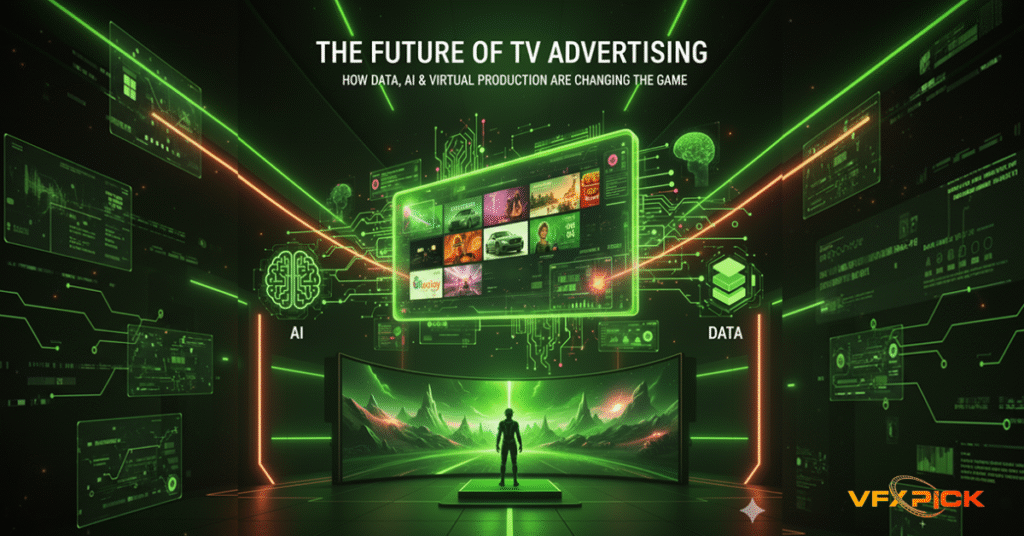
- Television advertisement has always been considered one of the most effective methods of reaching masses of people by the brands.
- However, the scenery is not what it used to be ten years ago. Modern audiences watch on various platforms, watch the media on their phones, and demand personalized and high-quality experiences. Consequently, the standard TV advertisements, which were characterized by large budgets and general communication, are changing very fast.
- At the core of this evolution are data, artificial intelligence (AI) and virtual production.
- The three forces are transforming the manner in which TV ads are planned, created, delivered and measured.
- The future of TV advertising lies in the precision they adopt instead of the guesswork, in the automation instead of the manual work and in the cinematic invention instead of the conventional commercial production.
We discuss in this blog the impact of strategies based on data, automated optimization with AI and sophisticated virtual production processes on the TV advertising ecosystem.
1.From Mass Appeal to Precision: How Data Is Rewriting The Future Of TV Advertising
- Marketers can finally track how TV ads influence consumer actions and funnel outcomes. This data-driven advertising allows campaigns to be optimized dynamically, something impossible in the past.
- The TV advertising formula has been so basic over the decades: identify prime time, create an advertisement with some catchy appeal and hope that it translates. However, the results of audience behavior can be monitored and content is scattered among platforms and in this age, data is the new currency.
Smarter Targeting Through Audience Insights
Sophisticated television platforms, such as connected TV (CTV), streaming services, and digital broadcasting networks, are currently providing demographic, behavioral and preference information on viewers in a granular manner. Brands do not have to continue counting on such broad indicators as age groups or channel popularity. Instead, they can target:
- Households that are concerned with certain products.
- Buyers with a history of buying.
- The lifestyle and interests of the target audiences are important factors to consider.
- Areas that have high conversion potential.
This change from mass reach to precision reach makes the ad more relevant and enhances campaign ROI.
Better Measurement and Attribution
In the past, it was a hard task to gauge the success of a TV campaign. Measurement tools now have the capability of being data-enabled to offer:
- On-the-fly performance indicators.
- Cross-device attribution (TV mobile purchase).
- View-through rates
- Brand lift analysis
The marketers can also ultimately monitor the impact of data-driven advertisements and divert the consequences to consumer behavior. Such transparency enables campaigns to be dynamically optimized, as was not the case before.
2.Is AI The Brain Behind Modern TV Advertising?
In case data is the fuel, AI is the engine that processes it to make advertising faster, smarter and more adaptive.
AI-Powered Media Buying
AI models process huge amounts of data to automate the processes involved in media buying. They assist the advertisers to know:
- The best time slots
- The appropriate channels (broadcast, CTV, OTT, digital streaming)
- Optimal frequency and reach
- Performance-based budget allocation.
This is not guesswork; the decisions are supported by the data-driven advertising that considers seasonality, audience behavior and past performance.
Hyper-personalized media
AI allows brands to provide personalized variations of the same ad, which is a booming feature in the future of TV advertising. For example:
- Modifying the product characteristics as per the audience’s interest.
- Switching to the local language or accent for local viewers.
- Personalizing market offers.
- Changing images according to the audience.
It is scalable with the help of dynamic creative optimization (DCO) that is driven by AI. Contemplate a thousand variations of a 30-second spot—all customized, all autonomous.
Creative Production With the Help of AI
Outside the field of analytics, AI is now applied in the creative process:
- Scriptwriting suggestions
- Automated voiceovers
- Style and tone adjustments
- Facial reanimation and dubbing.
- Generative storyboarding
This type of tool saves time in the production process and as a part of the future of TV advertising, it enables creative teams to test various concepts in a short period of time.
3.Virtual Production Is The Cinematic Revolution In The Future Of TV Advertising.
In case AI modifies the way TV advertisements are scheduled and optimized, virtual production is a change in the way they are made. This technology has been popularized by Hollywood and combines real-time 3D settings, LED walls, motion capture and VFX to create immersive scenes without the need to shoot on location.
Why Virtual Production Is Becoming a Game-Changer in the future of TV Advertising
a.Limitless Creative Potentials.
The advertisers can put the actors in the futuristic city, the snowy mountain, or the luxury penthouse and not go to the studio. The amazing VFX crew, like the VFXPick, creates breathtaking 3D sets that react to the actual movements of the camera, which can be felt as reality.
b.Faster Turnaround Times
Virtual sets may be reused, changed, or extended immediately. In the case of some industries, such as automotive, travel, or consumer electronics, this enables shooting a series of ads very fast.
c.Cost Efficiency
There is no travel, no weather slips and fewer logistics. The brands will be able to create blockbuster-level visuals with only a fraction of the cost.
d.Uniformity in the International Markets.
It is not difficult to create region-specific variants of the same ad in a virtual environment, which was not possible with traditional shoots.
Real-Time Collaboration
Cinematographers, brand teams, VFX artists and directors are able to work together in real time on set. Would you prefer to switch on/off lights, background colors, or the depth of the environment? It can be done instantly with data-driven advertising. This minimizes reshoots and hastens the decision-making process.
4.The Convergence: When Data, AI & Virtual Production Work Together
The ultimate magic is when these three innovations are combined.
Intelligent Data Feeds Can Promote Innovative Thinking.
Statistics show what viewers react to. AI interprets such insights and proposes innovative paths. The ideas are then implemented through virtual production, allowing teams to quickly create quality variations based on audience segmentation, which is a significant trend in the future of TV advertising.
Data-driven advertising, programmatic creative renewal.
Brands can now run the same TV commercial for months instead of running it.
- Update backgrounds
- Refresh product details
- Modify messaging
- Modify scenes for seasonal promotions.
all without reshoots. Creative agility can not only be expected but is achievable thanks to virtual production and AI.
Closed-Loop Optimization
Campaigns turn into living systems:
- The TV ad runs.
- Data flows back.
- AI analyzes performance.
- Creative differences are generated.
- The images are changed through virtual production.
- Optimized versions are reinstated.
This loop transforms television advertising into a performance-based cycle.
5.Expectation In The Future Of TV Advertising
With the maturity of data-driven advertising, TV advertisements will be smarter and more engaging. We can expect:
- Wholly artificial intelligence-created advertisements.
- Switching of advertisements in real time depending on the mood or context of the viewer.
- Bidirectional virtual-physical shoot systems.
- Use 3D digital humans as spokespeople for the brand.
- Further integrated analytics between television and streaming.
Those who capture this transformation will have unprecedented control, creativity and efficiency in their brands.
Conclusion
The future of TV advertising is not only about the improved narration but also about the accuracy of data, AI-based automation and the virtual production technologies that are spectacular to see. Collectively, experts like VFXPick are harnessing data-driven advertising and are redefining the future of TV advertising in design, execution and assessment. The brands that succeed in the next decade will be creative, smart, imaginative and innovative.
FAQS
1. What is the future of TV advertising?
The future of TV advertising is in the form of data-driven advertising, AI-driven targeting, and virtual production that would allow the development of personalized and highly influential campaigns.
2. How does data-driven advertising improve TV campaigns?
Data-driven advertising assists brands to target certain audiences, optimize their spending, and measure their performance more effectively on television and streaming outlets.
3. How is AI shaping the future of TV advertising?
AI automates the process of buying media, creates more creative content, forecasts effectiveness, and facilitates more intelligent decision-making to make TV advertising more efficient.
4. What role does virtual production play in modern TV ads?
Virtual production enables brands to produce high-quality immersive visuals at a low cost to enable TV advertising to be more flexible, scalable, and interesting.