
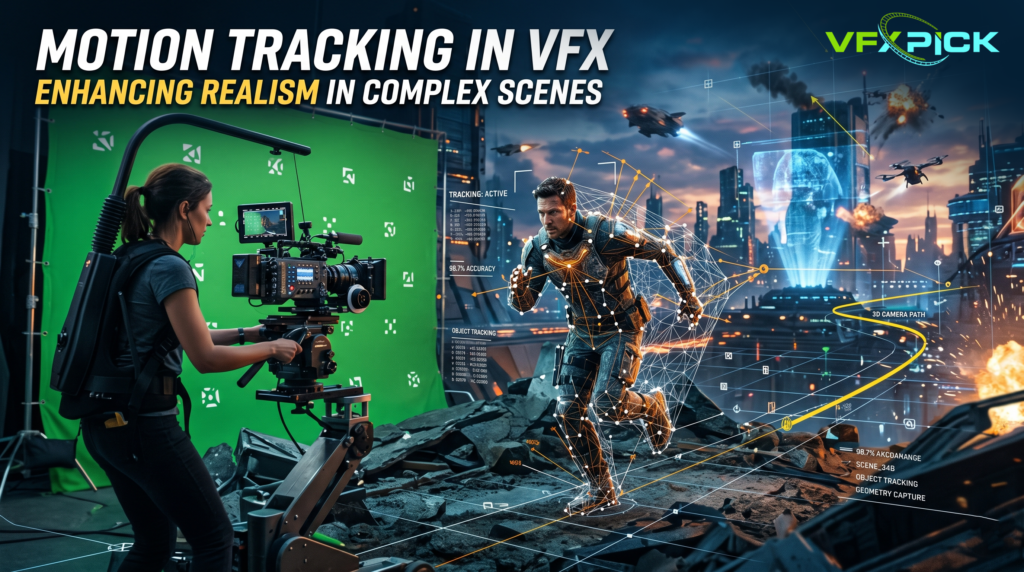
- Motion Tracking in VFX is one of the important features that helps to produce elaborate VFX which looks realistic and immersive. Motion tracking provides tools to track the camera’s and objects movements, and can be applied to accurately match CGI elements to live-action footage.
- It is similar technology that is used to maintain perspective, light and shadow, and motion continuity throughout a scene, so that digital assets can be a part of the scene. Better accuracy and repeatability for action shots, virtual environments and animated effects are also achieved, minimizing variations in imagery and improving the motion tracking.
- Use of Motion Tracking in VFX for visually interesting and immersive scenes, for blockbuster films, for game cinematics, ads and virtual production are just a few examples.
Introduction
In the film world today, the use of VFX has become essential to creating ‘worlds’ which completely engage the viewers, amazing action sequences and realistic digital settings. From super hero films to science-fiction epics to advertisements, visual effects are a critical element to storytelling in film. However, one of the greatest challenges of VFX production is how to make digital elements seamlessly integrate into live-action footage. That’s where Motion Tracking in VFX can come in handy.
Motion tracking is the process of tracking and recording the movement of objects or cameras in a scene. This enables computer generated imagery (CGI) to move in line with the real footage. It may be a futuristic cityscape, moving creatures or intensified explosions and destruction, but all of it feels grounded in reality thanks to motion tracking.
The need for realism in film is increasing and studios are turning to professional VFX motion tracking companies to ensure there is accurate tracking for their more demanding scenes. Motion tracking is not limited to the images; it helps tell the story in a better way and scenes which would have simply not been able to be captured look realistic and believable.
Understanding Motion Tracking in VFX
The idea of motion tracking in visual effects is simply following the camera path or object’s movement in the real-time video and converting the movement into digital data. This information is used to create the perfect fit for computer-generated parts in the original footage. It enables visual effect artists to blend digital components into scenes seamlessly, with all of the elements being fully believable through advanced VFXPick Studio motion tracking expertise.
Motion tracking is a vital aspect of VFX that will be discussed in the following article, in which there are primarily two types of motion tracking.
1. Camera Tracking
Sometimes referred to as match moving, camera tracking is the process of locating the people in the image. This includes capturing the motion of a camera in a specific location. It’s super crucial for inserting 3D objects into real life footage. As the camera moves, we can use the tracking to verify that any digital elements which are added remain in the proper perspective and depth and remain in sync throughout the shot. Suppose the film maker wanted to throw huge buildings, spaceships or even fantasy creatures into a city scene, and they want those buildings, spaceships, or fantasy creatures to move precisely as they did in the original video, then it is camera tracking that will help them achieve this.
2. Object Tracking
Object tracking is a technique for tracking the movement of a particular object in a frame. It is a standard way of screen replacement, visual enhancement or digital effects on a moving object.
An example of these types of technologies are object tracking, which are used to replace a green screen smartphone screen with animation graphics or to add glowing visual effects to a moving vehicle.
The Importance of Motion Tracking in Complex Scenes
The ability to seamlessly integrate digital content with live-action environments is one of the most remarkable features of Motion Tracking in VFX. Motion tracking allows digital objects to move in the same way as the camera and to interact with the environment in a realistic manner.
This is especially true in action scenes where the explosion, debris, and animated figures must perfectly match the camera’s movement.
Seamless Integration of CGI
One of the most significant benefits of Motion Tracking in VFX is the flawless blending of digital assets with live-action settings. Motion tracking enables digital objects to follow the natural movement of the camera and to interact realistically with the environment.
This is particularly true in action sequences where explosions, debris, and animated characters have to perfectly match the camera’s movement.
Enhanced Realism
In today’s world of contemporary visual storytelling, realism is essential. Poorly integrated effects are easily identified by today’s audiences. Motion tracking lets the artist replicate the realism of movement, shadows, reflections and interactions between the CGI and real world elements.
Professional VFX motion tracking services guarantee the consistency of each frame, creating a convincing image of the final shot.
Improved Efficiency in Post-Production
Common factors in complex scenes are quick camera motion, multiple moving subjects, varying light and complex environments. If not properly tracked, the CGI elements may end up looking detached from the scene, affecting the quality and realism of the scenes produced.
Better Camera Stabilization
The best part of Motion Tracking in VFX is that it blends flawlessly with the live-action setting. Motion tracking allows digital objects to follow real camera motion, and to interact realistically with the surrounding.
Especially during action scenes, where, for example, explosions and debris must match the camera’s path, activated by animated characters.
Applications of Motion Tracking in VFX
Motion Tracking in VFX is widely used across multiple industries and entertainment formats.
Film and Television
In movies, motion tracking is extensively used for large scale VFX. Motion tracking can also be used to seamlessly blend CGI with real-world footage—be it a super hero morphing or aliens invading.
Advertising and Commercials
With motion tracking, brands can produce thrilling ads that feature animated graphics, moving text and interactive visual effects which follow the movement of objects in the scene.
Gaming Cinematics
Motion tracking also helps game developers achieve seamless integration of live-action footage with computer-generated imagery (CGI) in their games.
Virtual Production
With virtual production setups, where the virtual backgrounds will interact with the camera in realtime and dynamically, the need for tracking is increasing in significance.
Augmented Reality and Mixed Reality
In AR and MR applications that require accurately locating digital objects in real-world environments, motion tracking is likely a critical element.
Challenges in Motion Tracking
Despite the benefits, Motion Tracking in VFX has its own technical challenges.
Fast Motion and Motion Blur
Tracking software may struggle to find precise tracking points and fast movements can result in motion blur.
Occlusion
It is more difficult to track an object which is temporarily obscured by other objects.
Lighting Variations
Tracking markers can be affected by different lighting, and may cause inaccuracy.
Reflective Surfaces
Highly reflective and transparent surfaces can cause poor tracking data.
Professional VFX motion tracking services have the ability to overcome such challenges by employing advanced technology, AI algorithms, and skilled artists to achieve precise tracking results.
Key Features of Motion Tracking in VFX
Accurate Camera Reconstruction
Motion tracking software recreates the exact movement of the camera, so that CGI can be integrated realistically.
Marker-Based Tracking
Very accurate tracking: physical markers set on set to make reference points.
Markerless Tracking
More advanced AI systems can also track movement without the use of physical markers, allowing for greater flexibility during production.
Real-Time Tracking
Modern motion tracking systems can give immediate feedback allowing for quicker decisions to be made during filming.
3D Environment Mapping
For more advanced systems, motion tracking can also be performed using AI, offering more flexibility during production.
Stabilization and Cleanup
Current motion tracking systems can provide instant feedback and make decisions during filming, which is faster.
High-Speed Motion Capture
Tracking tools can be used to capture depth and perspective for creating realistic 3D space
Integration with CGI Pipelines
Motion tracking seamlessly combines with animation, compositing and rendering workflows.
The Future of Motion Tracking in VFX
Artificial intelligence and machine learning technologies are rapidly changing the future of Motion Tracking in VFX. AI-based tracking systems are increasingly adept at tracking in environments with low light, high speed and complex environments.
Real time tracking systems are also being innovated, with virtual production techniques, popularized by high budget movie sets, driving the innovation. All of this means that the filmmakers can view the CGI environments on the fly while they’re shooting, which cuts down on post-production time and provides them with more creative control.
Cloud-based collaboration tools and automation are also driving the industry’s transformation, enabling global teams to work together on motion tracking projects effectively.
With increasingly high expectations from viewers, studios will increasingly need advanced VFX motion tracking services to achieve the cinematic effect at a large scale.
Conclusion
Motion Tracking of VFX is one of the key technologies to create realistic and immersive visual effects in modern filmmaking. Motion tracking is accurately tracking the motion of both the camera and the object and allows you to precisely add the CGI in highly complex scenes with a high level of realism.
In the world of cinema, gaming visuals, and advertising, motion tracking is a revolution in digital storytelling—from blockbuster movies to gaming visuals, it continues to push the boundaries of what’s possible. With the progress of AI, real-time rendering and automations, the future of motion tracking looks even more promising, promising more accuracy and creative potential.
Professional VFX motion tracking services can produce a visually stunning experience, drawing in viewers from around the world. With evolving technology, Motion Tracking in VFX will remain the leading frontier of movie innovation and realism. Get in touch with our VFX experts today to create realistic and visually stunning motion tracking effects for your project.
FAQ's
1. What is Motion Tracking in VFX?
In VFX, Motion Tracking is the process of tracking the movement of the cameras or objects in live-action footage so that CGI elements can be properly integrated into the scene.
2. Why is motion tracking important in visual effects?
Motion tracking is used to achieve realistic visual effects, ensuring that digital elements move naturally with the original footage, resulting in improved immersion and visual consistency.
3. Where are VFX motion tracking services commonly used?
VFX motion tracking services are used extensively in film, television, gaming cinematics, commercials, virtual production and augmented reality experiences.
4. How does motion tracking improve complex scenes?
Motion tracking helps with complex scenes because it keeps everything in line. This means that the perspective, lighting and interaction of objects will all be accurate. This makes the CGI look more real and believable.